Wildlife corridors, bridges & belts
SYNERGIES / Human wellbeing
Definition
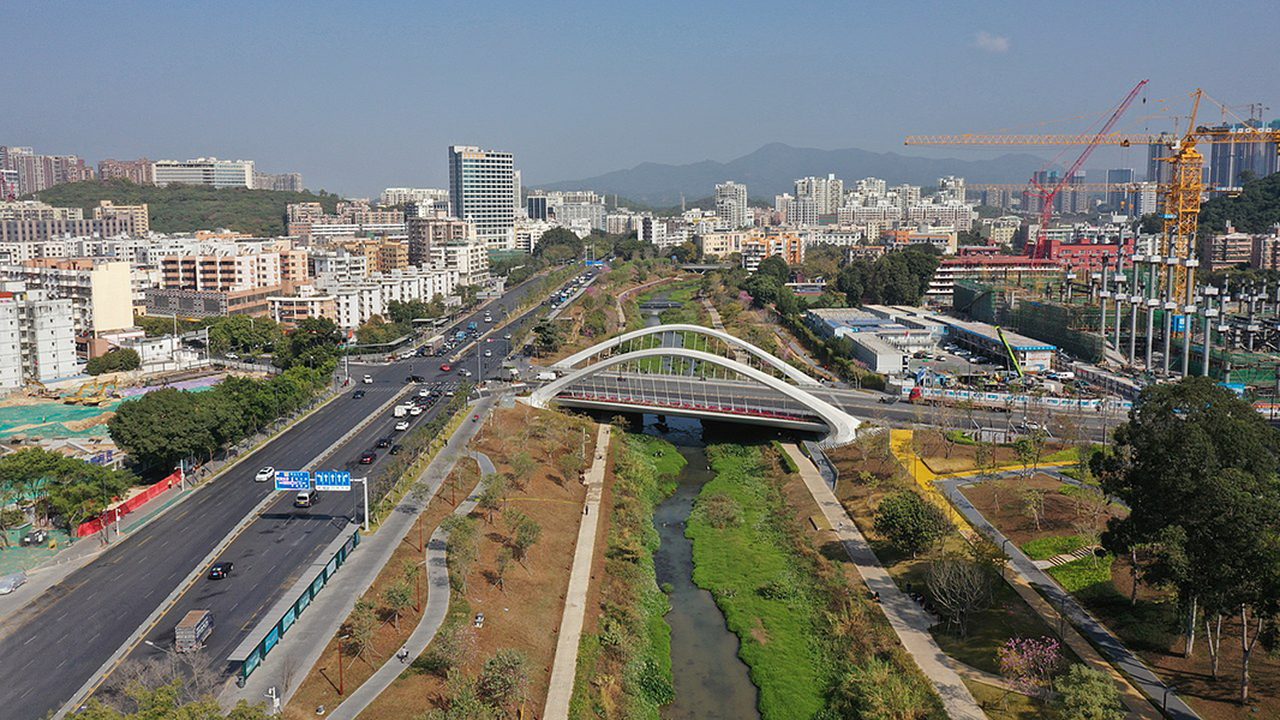
Connected networks of vegetated or aquatic spaces that enable movement of species across fragmented urban landscapes.
What this strategy does
Links isolated habitats using linear green or blue elements (e.g. corridors, bridges, riparian belts). Avoids isolated “green islands” with no functional connectivity.
Context
Urban development in Aotearoa New Zealand has fragmented Indigenous habitats, limiting species movement and ecological function. Corridors are a recognised mechanism for improving functional connectivity where large, continuous reserves are not feasible1.
Technical considerations
Design considerations
Spatial connectivity
- Design corridors to physically link existing habitat patches, prioritising continuous vegetation cover or water pathways over fragmented planting1.
Vegetation structure
- Provide multi-layered native vegetation (canopy, understory, groundcover) rather than relying on tree-only planting, as structural diversity is more strongly associated with increased urban biodiversity2.
Integrated green infrastructure
- Where ground-level continuity is constrained, use green roofs, green walls, or riparian systems as stepping-stone connections, recognising that performance depends on substrate depth, planting diversity, and microclimate suitability3, 4.
Implementation considerations
- Align corridor routes with existing reserves, waterways, and street networks to maximise continuity and minimise land acquisition requirements1.
- Corridors alone do not protect vulnerable native fauna from introduced predators; predator control or exclusion measures are often required for ecological effectiveness in Aotearoa New Zealand5.
- Least-cost path and resistance modelling may support corridor alignment and prioritisation at neighbourhood and city scales depending on context 6.
Issues & barriers
Habitat fragmentation
- Limited space in dense urban areas can reduce corridor width and continuity, constraining effectiveness for some species5.
Predation pressure
- Introduced mammalian predators significantly limit biodiversity outcomes where habitat creation is not paired with pest management5.
Planning integration
- Biodiversity is often considered late in urban design processes or may only be instigated at a single site scale, reducing opportunities to embed continuous corridors across multiple sites or developments7.
Synergies & opportunities
- Climate change – Vegetated corridors contribute to urban cooling and microclimate regulation, supporting climate adaptation benefits alongside biodiversity outcomes.8
- Human wellbeing – Access to connected, biodiverse green spaces is associated with improved psychological wellbeing and restorative experiences9, 10, 11.
- Freshwater security – Riparian and blue–green corridors can improve stormwater attenuation, water quality, and flood resilience while supporting aquatic and terrestrial connectivity12.
Financial case
Ecosystem services & performance value
- Infrastructure cost reduction: Blue–green corridors can reduce reliance on engineered stormwater infrastructure and associated long-term maintenance costs12, 13.
Cost-effectiveness: Investment logic
- When embedded early at a network scale, corridors deliver multiple co-benefits such as biodiversity, climate adaptation, and wellbeing from shared land and infrastructure investments13.
Monitoring & evaluation metrics
Core metric
- Change in Indigenous vegetation cover, patch size, and connectivity (e.g. least-cost path distance between habitat nodes)1, 6.
Advanced or long-term metric
- Presence, abundance, or movement of indicator native species using council or Department of Conservation monitoring datasets1.
Additional resources or tools
- Ecological corridors and habitat connectivity guidance. Design and policy considerations for corridor planning in New Zealand landscapes.
- Restoring urban and rural ecosystems. Guidance on habitat restoration, connectivity, and biodiversity outcomes.
References
- Nguyễn, T., Meurk, C., Benavidez, R., Jackson, B., & Pahlow, M. (2021). The effect of blue-green infrastructure on habitat connectivity and biodiversity: A case study in the Ōtākaro/Avon River catchment, Christchurch, New Zealand. Sustainability, 13(12), 6732. https://doi.org/10.3390/su13126732
- Threlfall, C., Mata, L., Mackie, J., Hahs, A., Stork, N., Williams, N., & Livesley, S. (2017). Increasing biodiversity in urban green spaces through simple vegetation interventions. Journal of Applied Ecology, 54, 1874–1883. https://doi.org/10.1111/1365-2664.12876
- Mayrand, F., & Clergeau, P. (2018). Green roofs and green walls for biodiversity conservation: A contribution to urban connectivity? Sustainability, 10, 985. https://doi.org/10.3390/su10040985
- Wang, L., Wang, H., Wang, Y., Che, Y., Ge, Z., & Mao, L. (2022). The relationship between green roofs and urban biodiversity: A systematic review. Biodiversity and Conservation, 31, 1771–1796. https://doi.org/10.1007/s10531-022-02436-3
- Wallace, K., & Clarkson, B. (2019). Urban forest restoration ecology: A review from Hamilton, New Zealand. Journal of the Royal Society of New Zealand, 49(sup1), 347–369. https://doi.org/10.1080/03036758.2019.1637352
- MacKinnon, M., Pedersen Zari, M., & Brown, D. (2023). Improving urban habitat connectivity for native birds: Using least-cost path analyses to design urban green infrastructure networks. Land, 12(7), 1456. https://doi.org/10.3390/land12071456
- Hernandez-Santin, C., Amati, M., Bekessy, S., & Desha, C. (2023). Integrating biodiversity as a non-human stakeholder within urban development. Landscape and Urban Planning, 230, 104678. https://doi.org/10.1016/j.landurbplan.2022.104678
- Schmidt, K., & Walz, A. (2021). Ecosystem-based adaptation to climate change through residential urban green structures. One Ecosystem, 6, e65706. https://doi.org/10.3897/oneeco.6.e65706
- Cameron, R., et al. (2020). Do urban green spaces with greater avian biodiversity promote more positive emotions? Urban Ecosystems, 23, 301–317. https://doi.org/10.1007/s11252-020-00929-z
- Schebella, M., et al. (2019). Wellbeing benefits associated with perceived and measured biodiversity. Sustainability, 11(3), 802. https://doi.org/10.3390/su11030802
- Fisher, J., et al. (2020). Perceived biodiversity and restorative quality of green and blue space. Science of the Total Environment, 755, 143095. https://doi.org/10.1016/j.scitotenv.2020.143095
- Alves, A., et al. (2019). Co-benefits of green-blue-grey infrastructure for flood risk management. Journal of Environmental Management, 239, 244–254. https://doi.org/10.1016/j.jenvman.2019.03.036
- Daigneault, A., Eppink, F., & Lee, W. (2017). A national riparian restoration programme in New Zealand: Is it value for money? Journal of Environmental Management, 187, 166–177. https://doi.org/10.1016/j.jenvman.2016.11.013
RELATED DESIGN STRATEGIES //
Specific design interventions that support ecological health, habitat quality, and species diversity across urban and built environments.