
Definition
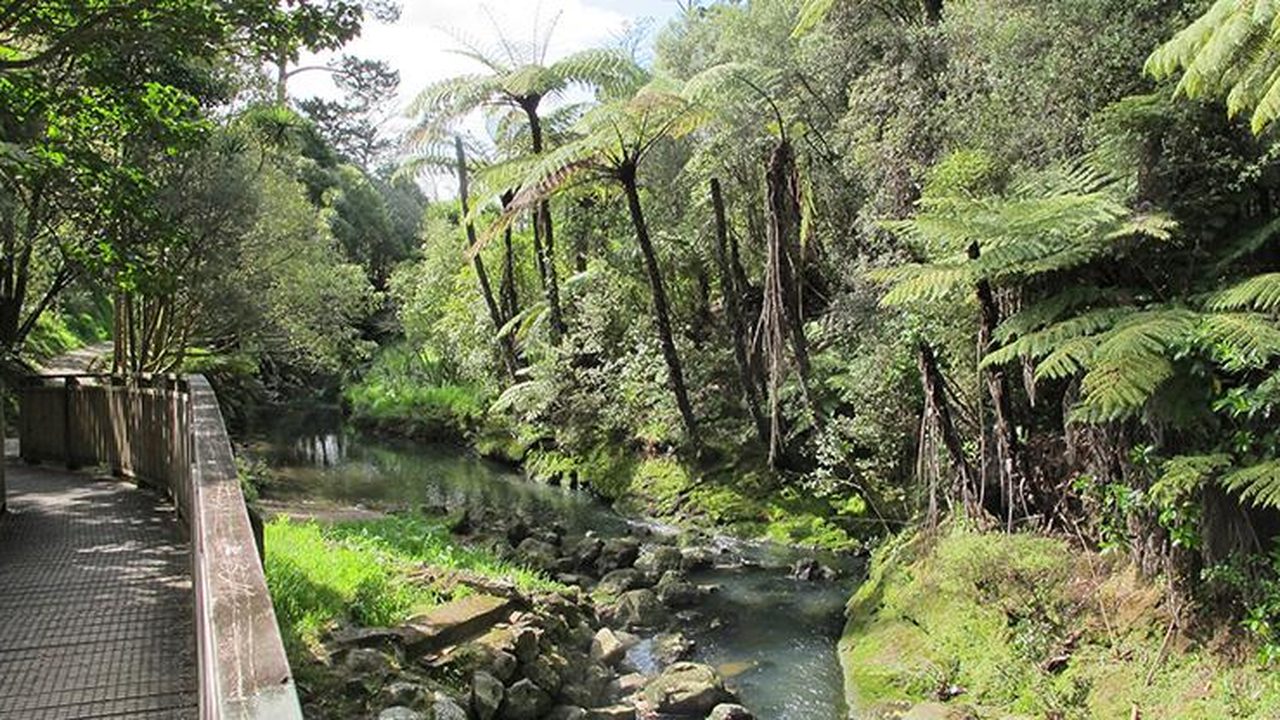
Urban riparian restoration and shading restores vegetated margins along urban waterways using native planting to create continuous or semi-continuous canopy cover that supports freshwater health, biodiversity connectivity, and urban microclimate regulation.
What this strategy does
Re-establishes native riparian vegetation to shade channels, stabilise banks, filter runoff, and provide habitat. Avoids isolated or purely ornamental plantings that do not achieve canopy closure or connectivity.
Context
In Aotearoa New Zealand cities, highly modified channels, fragmented habitats, and warming urban streams mean riparian shading is a primary, defensible intervention for freshwater resilience and biodiversity recovery at neighbourhood to landscape scales.1
Technical considerations
Design considerations
Primary objectives
Clarify whether cooling, water quality, habitat, erosion control, or amenity is the priority, as trade-offs occur between shading, macrophyte growth, and in-stream productivity.2, 3
Spatial scale
Plan riparian restoration at catchment scale; short, isolated reaches rarely shift aquatic communities without canopy continuity and upstream protection.4, 5, 6
Buffer width and configuration
Target buffers ≥10–20 m where space allows to maximise filtration, habitat complexity, and net benefits; use variable-width, tiered buffers responding to geomorphology and floodplain processes.7, 8
Shading and thermal performance
Small urban streams benefit from moderate to high shade to reduce temperature and eutrophication risk, but complete shading can suppress aquatic plant diversity; balance canopy density with channel form and edges.3, 9
Planting structure (NZ context)
Use multi-layered native planting (trees, shrubs, ground layer) with species suited to bank stabilisation and natural recruitment; avoid tree-only strips that become weed-dominated.10, 11
Implementation considerations
Design priority
Protect headwaters and extend shaded reaches upstream; integrate planting with stormwater management and impervious-surface reduction.12
Key constraint
Channel incision, flashy urban hydrology (rapid, high-volume runoff with sharp peak flows), and hard-engineered banks limit ecological response even where vegetation is present.13
Issues and barriers
Physical and ecological limits
Highly modified channels and constrained corridors (“strangled rivers”) restrict buffer width and river space-to-move.13
Ecological time lags
Macroinvertebrate and fish recovery may take more than 10–20 years and often remains partial without long buffers and catchment protection.1, 6
Governance and delivery
Fragmented responsibilities and partial implementation of water-sensitive design reduce effectiveness.12
Synergies and opportunities
Climate change – Riparian shade reduces stream warming and improves resilience to climate-driven thermal stress; wider corridors support adaptive flood management.14
Human wellbeing – Shaded blue–green corridors improve thermal comfort, recreation, and cultural connection in urban environments.15, 16
Freshwater security – Riparian buffers reduce nutrients, sediment, and pathogens, with benefits exceeding costs at the national scale.7, 17
Financial case
Ecosystem services value
National modelling shows riparian restoration (5–50 m buffers) delivers net benefits of NZ$1.7–5.2 billion per year, largely through reduced greenhouse gases, nutrients, and sediment.7
Cost-effectiveness
Benefits accrue even without pricing biodiversity or amenity, making riparian shading a robust, low-regret investment.7
Monitoring and evaluation metrics
Core metrics
Buffer width, continuity, and upstream extent.17
Canopy shade (%) over channel.9
Stream temperature, nutrients, turbidity, dissolved oxygen.6, 9
Advanced metrics
Macroinvertebrate indices (MCI, QMCI, EPT richness).6
Riparian vegetation structure and regeneration.10, 18
Additional resources or tools
DairyNZ Stream Restoration Planner
Customised fencing and planting plans for riparian areas.
NIWA Riparian Management Calculator
Site-specific guidance for shading and water-quality outcomes.
Monitoring indicators for riparian restoration success.
References
- McKergow, L., Matheson, F., & Quinn, J. (2016). Riparian management: A restoration tool for New Zealand streams. Ecological Management and Restoration, 17, 218–227. https://doi.org/10.1111/emr.12232
- Mouton, T., Matheson, F., Stephenson, F., Champion, P., Wadhwa, S., Hamer, M., Catlin, A., & Riis, T. (2019). Environmental filtering of native and non-native stream macrophyte assemblages. Science of the Total Environment, 659, 1370–1381. https://doi.org/10.1016/j.scitotenv.2018.12.277
- Burrell, T., O’Brien, J., Graham, S., Simon, K., Harding, J., & McIntosh, A. (2013). Riparian shading mitigates stream eutrophication. Freshwater Science, 33, 73–84. https://doi.org/10.1086/674180
- Parkyn, S., Davies-Colley, R., Halliday, N., Costley, K., & Croker, G. (2003). Planted riparian buffer zones in New Zealand. Restoration Ecology, 11. https://doi.org/10.1046/j.1526-100x.2003.rec0260.x
- Collier, K., Aldridge, B., Hicks, B., Kelly, J., Macdonald, A., Smith, B., & Tonkin, J. (2009). Ecological values of Hamilton urban streams. New Zealand Journal of Ecology, 33, 177–189.
- Doehring, K., Clapcott, J., & Young, R. (2019). Functional response to streamside fencing of pastoral Waikato streams, New Zealand. Water, 11. https://doi.org/10.3390/w11071347
- Daigneault, A., Eppink, F., & Lee, W. (2017). A national riparian restoration programme in New Zealand: Is it value for money? Journal of Environmental Management, 187, 166–177. https://doi.org/10.1016/j.jenvman.2016.11.013
- Luke, S., Slade, E., Gray, C., et al. (2018). Riparian buffers in tropical agriculture: Scientific support, effectiveness and directions for policy. Journal of Applied Ecology. https://doi.org/10.1111/1365-2664.13280
- Forio, M., De Troyer, N., Lock, K., et al. (2020). Small patches of riparian woody vegetation enhance biodiversity of invertebrates. Water, 12. https://doi.org/10.3390/w12113070
- Foley-Congdon, E., Jellinek, S., Chee, Y., & Greet, J. (2024). Revegetated riparian areas are dominated by weeds and lack structural diversity. Restoration Ecology, 32. https://doi.org/10.1111/rec.14098
- Boothroyd, I., Quinn, J., Langer, E., Costley, K., & Steward, G. (2004). Riparian buffers mitigate effects of pine plantation logging on New Zealand streams. Forest Ecology and Management, 194, 199–213. https://doi.org/10.1016/j.foreco.2004.02.018
- Van Roon, M. (2020). Demonstrating the need to simultaneously implement all water sensitive design methods for aquatic ecosystem health. Heliyon, 6. https://doi.org/10.1016/j.heliyon.2020.e05682
- Brierley, G., Hikuroa, D., Fuller, I., et al. (2022). Reanimating the strangled rivers of Aotearoa New Zealand. WIREs Water, 10. https://doi.org/10.1002/wat2.1624
- Capon, S., Chambers, L., Mac Nally, R., et al. (2013). Riparian ecosystems in the 21st century: Hotspots for climate change adaptation. Ecosystems, 16, 359–381. https://doi.org/10.1007/s10021-013-9656-1
- Schmidt, K., & Walz, A. (2021). Ecosystem-based adaptation to climate change through residential urban green structures. One Ecosystem. https://doi.org/10.3897/oneeco.6.e65706
- Nguyễn, T., Meurk, C., Benavidez, R., et al. (2021). The effect of blue–green infrastructure on habitat connectivity and biodiversity in Christchurch. Sustainability, 13. https://doi.org/10.3390/su13126732
- Collins, K., Doscher, C., Rennie, H., & Ross, J. (2013). The effectiveness of riparian restoration on water quality. Restoration Ecology, 21. https://doi.org/10.1111/j.1526-100x.2011.00859.x
- Pace, G., Gutiérrez-Cánovas, C., Henriques, R., et al. (2022). Remote sensing indicators to assess riparian vegetation and river ecosystem health. Ecological Indicators. https://doi.org/10.1016/j.ecolind.2022.109519
- Feio, M., Hughes, R., Callisto, M., et al. (2021). The biological assessment and rehabilitation of the world’s rivers. Water, 13. https://doi.org/10.3390/w13030371