Location: Wellington region, Aotearoa New Zealand
Project type: State highway infrastructure project
Delivery/lead organisations: Waka Kotahi NZ Transport Agency; Transmission Gully Ltd
Date/period: Construction 2014–2021; opened 2022
Scale: Landscape / Catchment
Primary system or theme: Freshwater systems, erosion and sediment control, infrastructure environmental mitigation
Context
Why this site matters
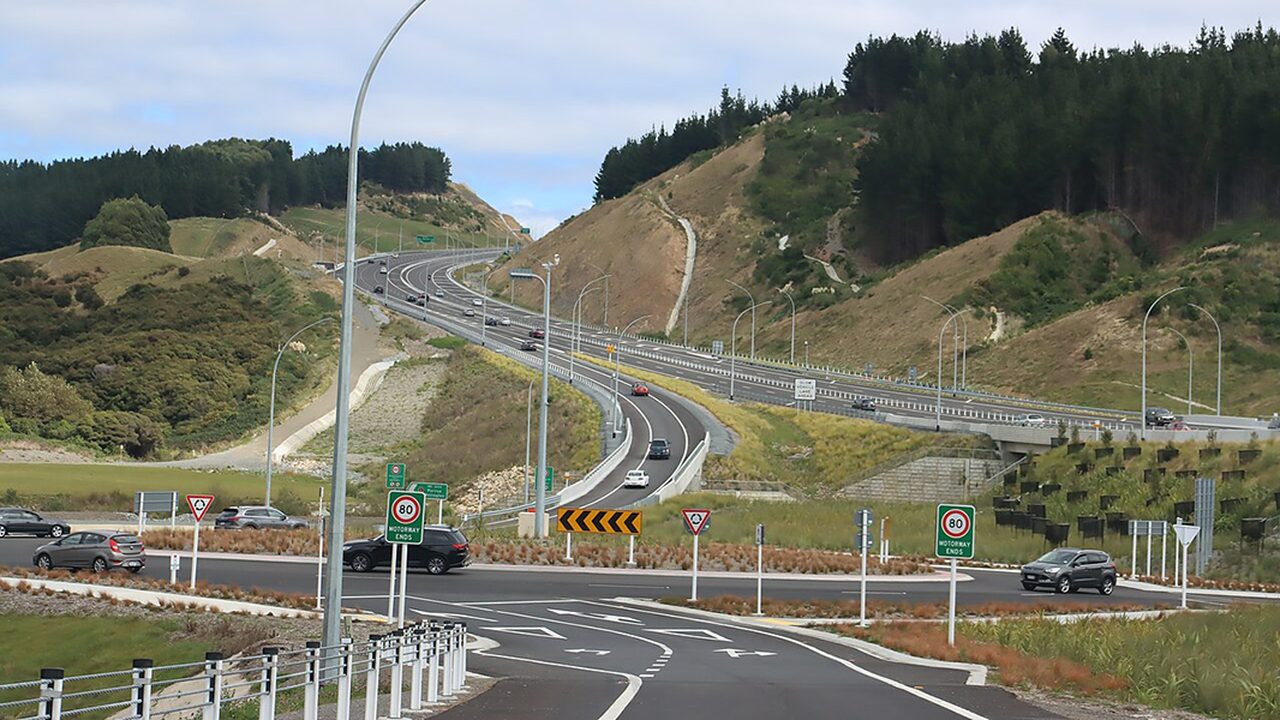
The Transmission Gully Motorway is a 27 km inland transport corridor forming part of the Wellington Northern Corridor, crossing steep terrain and multiple catchments draining to Porirua Harbour and the Pāuatahanui Inlet. 1, 2 These receiving environments are nationally recognised as sensitive to sedimentation and water-quality degradation.
Challenge or constraint
What wasn’t working/what needed to change
Large-scale earthworks on erodible soils and steep slopes posed a high risk of sediment discharge, runoff contamination, and slope instability during both construction and operation. 3 Regulatory approvals required demonstrable management of these risks, rather than net ecological enhancement.
Intervention
What was done
The project implemented a comprehensive, consent-driven environmental management framework focused on mitigating adverse effects.
Key components
- Construction-phase erosion and sediment control (sediment retention ponds, silt fencing, runoff diversion, staged stabilisation) 3
- Operational stormwater treatment systems to reduce road-runoff contaminants 3, 4
- Large-scale revegetation and land rehabilitation using eco-sourced native planting 5
- Fauna management measures, including identification, protection, and relocation of native species where required 3
- Pest plant and animal management within the motorway corridor 3
Implementation notes
Design & delivery considerations
- Controls were implemented primarily to meet consent compliance, not to deliver measured biodiversity uplift
- Performance depended on correct sequencing, maintenance, and adaptive management during construction 4
- Steep terrain and limited access required mechanised and aerial planting methods in some areas 6
- Long-term effectiveness relies on post-construction maintenance and clearly assigned operational responsibility 4
Outcomes
Observed or reported outcomes
- Implementation and operation of erosion and sediment control systems consistent with consent conditions 3, 4
- Installation of stormwater treatment infrastructure intended to reduce contaminant loads from motorway runoff 4
- Establishment of extensive areas of native vegetation as part of mitigation planting programmes 5
What is plausible but unmeasured
- Improved slope stability and reduced sediment yield over time as vegetation matures
- Incremental water-quality benefits in downstream catchments if systems are maintained as designed
- Limited habitat value of planted areas where structure and connectivity remain constrained
Evidence & limits
What the evidence supports
Available documentation demonstrates the implementation of mitigation measures and regulatory compliance, rather than verified long-term ecological or biodiversity outcomes. 3, 4
Key limitations or uncertainties
- Limited publicly available data on long-term water-quality or biodiversity performance
- Outcomes are highly context-dependent and contingent on ongoing maintenance
- Infrastructure corridors may facilitate pest movement, presenting unresolved ecological risks 7, 8
- Benefits are mitigation-oriented and should not be interpreted as restoration-equivalent
Relevance to design practice
- Large infrastructure projects can manage environmental risk through robust mitigation, but this should not be framed as ecological restoration
- Early integration of erosion, sediment, and stormwater design is essential in sensitive catchments
- Long-term governance and maintenance responsibilities must be explicit to avoid performance decline
- Avoid over-claiming biodiversity benefits where evidence demonstrates compliance rather than enhancement
References
- NZ Transport Agency. (2022). Transmission Gully motorway.
- Greater Wellington Regional Council. (2001). Environmental issues associated with Transmission Gully.
- NZ Transport Agency. (2022). Protecting our environment – Transmission Gully.
- NZ Transport Agency. (2024). Transmission Gully monitoring and benefit realisation report – September 2024.
- NZ Transport Agency. (2022). Landscaping and planting – Transmission Gully.
- NZ Transport Agency. (2019). Transmission Gully project newsletter – Spring 2019.
- Greater Wellington Regional Council. (2024). Roadkill and official information release shows growing mustelid pest problem for region.
- RNZ. (2023). No input from DOC into reports on environmental matters associated with Transmission Gully.