Location: Mt Roskill, Auckland, Aotearoa New Zealand
Project type: Residential subdivision stormwater infrastructure
Delivery/lead organisations: Roskill Development; Stormwater360 (supplier); Beca (engineering)
Date/period: 2018–2019
Scale: Site / Neighbourhood
Primary system or theme: Stormwater quality treatment (high-rate biofiltration)
Context
Why this site matters
The Owairaka subdivision is a high-density redevelopment within the Ōwairaka (Oakley Creek) catchment, an urban stream system subject to Auckland Council stormwater quality and hydrological controls. The project required effective stormwater treatment within a constrained urban footprint while meeting council performance expectations for discharge to receiving environments. 1, 2
Challenge or constraint
What wasn’t working/what needed to change
Available land area within the subdivision was insufficient to accommodate conventional low-rate raingardens designed under prescriptive Auckland guidance, necessitating an alternative stormwater treatment approach that could demonstrate equivalent contaminant removal performance within a smaller footprint. 3
Intervention
What was done
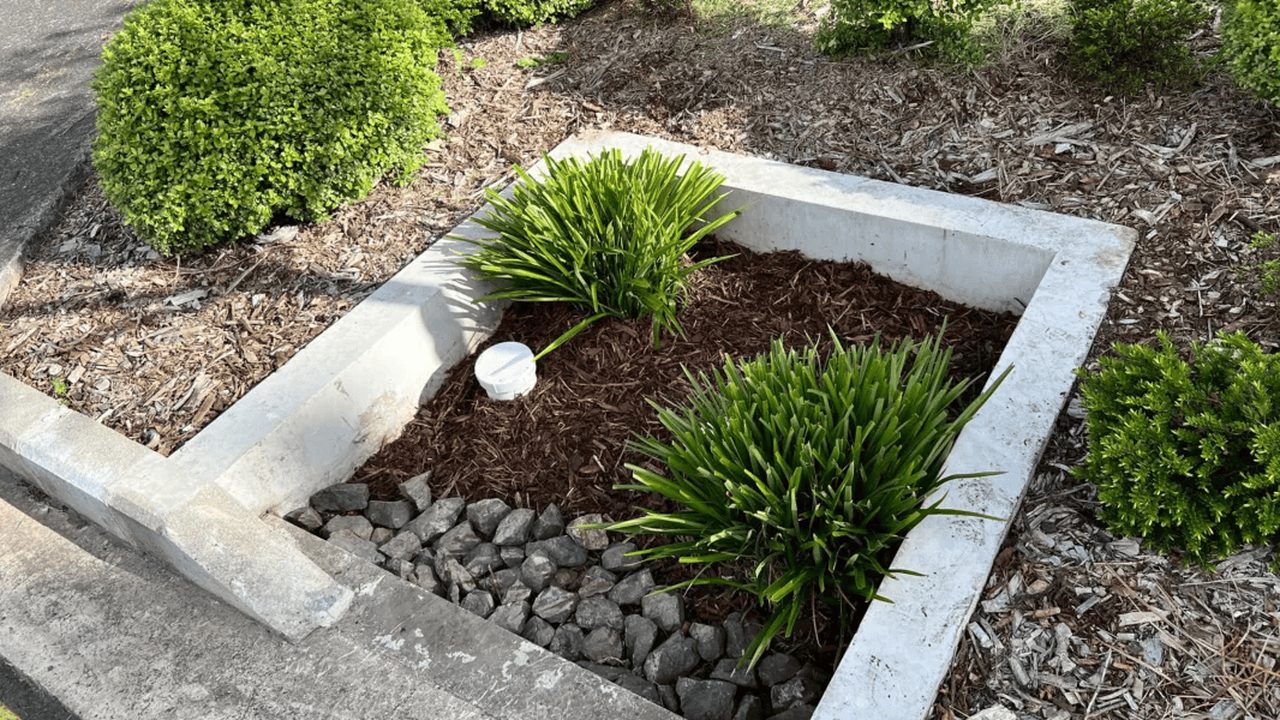
A proprietary Filterra® high-rate biofiltration system was installed as part of the subdivision’s integrated stormwater management strategy to treat runoff from impervious surfaces prior to discharge.
Key components
- Precast concrete biofiltration unit
- Engineered filter media and surface mulch
- Vegetated planting palette (including native species)
- Underdrain and overflow connection to the downstream network
Implementation notes
Design & delivery considerations
- Device selected using a performance-based equivalency approach rather than prescriptive sizing rules 3
- Approval required acceptance by Auckland Council that treatment objectives aligned with conventional biofiltration outcomes 1
- System performance is dependent on correct hydraulic loading, pretreatment, and ongoing maintenance
- Integrated within a wider site stormwater management plan rather than operating as a standalone solution 2
Outcomes
Observed or reported outcomes
- Provision of stormwater quality treatment consistent with Auckland Council approval requirements for the development 1, 2
- Demonstrated land-use efficiency relative to conventional raingarden footprints, enabling treatment within constrained site conditions 3
What is plausible but unmeasured
- Amenity value from vegetated surface
- Limited incidental ecological value associated with planted media
Evidence & limits
What the evidence supports
Performance-based studies indicate that, when appropriately designed and sized, high-rate biofiltration systems such as Filterra® can achieve contaminant load reductions comparable to conventional biofiltration systems under certain conditions. 3
Key limitations or uncertainties
- Evidence is based on equivalency assessments rather than long-term site-specific monitoring
- Performance is sensitive to maintenance regimes and inflow sediment loads
- Systems do not provide the broader ecological or habitat functions associated with larger, soil-based raingardens
- Findings should not be generalised beyond similar urban, space-constrained contexts
Relevance to design practice
- Use high-rate biofiltration where land constraints preclude conventional raingardens, but only within a performance-based regulatory framework
- Do not assume biodiversity, habitat, or amenity outcomes beyond stormwater treatment without site-specific evidence
- High-rate devices are best deployed as part of an integrated stormwater system, not as substitutes for catchment-scale water-sensitive design
References
- Stormwater360 Ltd. (n.d.). Filterra® at Owairaka Subdivision. Stormwater360.
- Beca. (2019). Stormwater management plan – Ōwairaka (Oakley Creek) (Report No. 3125416 NZ1-15454397-373). Roskill Infrastructure – Owairaka Development.
- Hannah, M., Poresky, A., & Reynolds, S. (2016). Evaluating the equivalency of a high-rate biofiltration BMP to traditional biofiltration. Proceedings of the 10th International Conference on Water Sensitive Urban Design.